Retail_cooling
Land-basedland

Compressor instability & control optimisation — retail supermarket chain

12–15%
Energy saving achieved
Resolved
Compressor short-cycling
24/7
Real-time monitoring active
The situation

System & context.

Location typeTwo retail supermarket branches
System type CO2 booster refrigeration (transcritical)
Temperature circuitsMedium temperature and low temperature
Compressor layoutMulti-compressor per circuit
What we walked into

Two supermarket branches operating identical CO2 booster refrigeration installations were assessed using the ClimaWISE performance analyser. Both locations showed frequent compressor short-cycling across medium and low temperature circuits, with compressors stepping up and down in load every few minutes during part-load operation. A Dynamic Fingerprint Baseline was established at the start of the project to capture the true performance signature of each installation under real operating conditions. This baseline became the reference against which all improvements were measured. Efficiency KPIs including compressor isentropic efficiency, system COP, and Energy Performance Index per branch were tracked in real time via ClimaWISE to quantify the impact of each intervention. One branch showed particularly unstable behaviour on its low temperature circuit, with one compressor running with a noticeably higher discharge temperature than the others.

Findings

What ClimaWISE found.

The fingerprint surfaces issues that show up nowhere else, not in the BMS, not in vendor diagnostics, not in scheduled service.

01: Evaporator — medium temperature circuit, branch 1
Unstable superheat drives evaporator efficiency KPI below acceptable range

During the measurement period both branches operated in part-load, with compressors starting and stopping every few minutes. The Dynamic Fingerprint Baseline revealed that compressor energy consumption was consistently above the expected curve for the actual operating conditions, confirming that the control strategy was the primary driver of excess energy use. After adjusting the staging logic to better match actual demand, compressor cycling frequency dropped significantly and the system COP KPI improved measurably against the baseline within the first weeks of operation.
highresolved
02: Gascooler fans — medium temperature circuit, branch 1
Uncontrolled fan operation prevents system from benefiting from low ambient conditions

ClimaWISE isentropic efficiency tracking flagged one compressor as consistently underperforming relative to its counterpart. The discharge temperature deviation pointed to a possible issue with oil management or refrigerant flow. After a targeted inspection, the root cause was identified and corrected. Post-intervention isentropic efficiency aligned with the expected KPI range and normalised against the Dynamic Fingerprint Baseline.

mediumresolved
03: Desuperheater controls — both branches
Transcritical night operation identified through ClimaWISE dynamic baseline deviation

The Dynamic Fingerprint Baseline for overnight periods — when heat load should be minimal — showed actual energy consumption significantly above the modelled curve. This confirmed that short cycling was driving excess consumption beyond what operating conditions could explain. Adjusting the control bandwidth and staging thresholds extended cycle times, brought overnight consumption back in line with the baseline, and reduced unnecessary mechanical wear.

highresolved
Results

What changed.

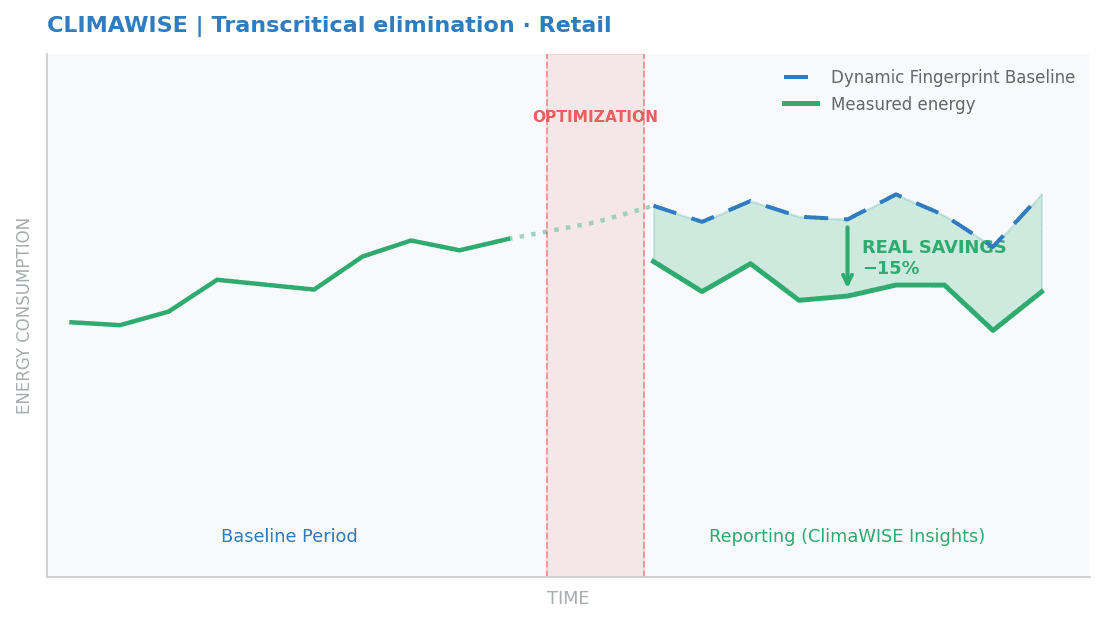
graph_land_case2_retail_transcritical.
12–15%
Energy saving vs dynamic baseline

ClimaWISE dynamic baseline corrected continuously for ambient temperature and store load, isolating true performance improvement from external variation.

74% → 82%
Gascooler approach efficiency

Condensing temperature now tracks ambient conditions closely during low ambient periods, capturing previously unused heat rejection capacity.

Eliminated
Unnecessary transcritical night operation

Identified exclusively through ClimaWISE dynamic baseline deviation analysis. Both branches now operate in subcritical mode during low heat load periods.

Sound familiar?

Recognise this in your own installation?

Let us read your fingerprint.